BAA, Buy America & BABA Compliant Lighting
A lighting professional's guide to BAA, Buy America, and BABA
Three federal programs govern lighting on publicly funded projects, and they are easy to confuse: the Buy American Act (BAA), Buy America (BA), and Build America, Buy America (BABA). They sound alike, they carry different thresholds, and they apply to different kinds of work. Made in USA is often grouped with them, but it is a separate marketing claim regulated by the Federal Trade Commission, not a procurement rule.
One principle sets the scope. Once a fixture is permanently installed in a federally funded building or piece of infrastructure, it falls under these rules. Portable and plug-in products generally do not. If it is affixed to the project, it needs to be covered.
For lighting professionals, the funding source usually decides which program applies before the project reaches you. The work for the specifier or lighting sales agency is different: identifying which products qualify, producing the documentation a submittal requires, and handling any items on a plan that cannot comply. This guide covers all three.
BAA, BA, and BABA: what each one covers
Most projects are governed by one program, determined by how the work is funded. A direct federal purchase points to BAA. A federally funded transit or infrastructure project points to BA or BABA. The table below is a quick reference.
| Program | What it governs | Applies to | US content threshold |
|---|---|---|---|
| Buy American Act (BAA) | Direct federal procurement | A federal agency buying the product itself | 65% US component cost, rising to 75% in 2029 |
| Buy America (BA) | Federally funded transit and infrastructure | FTA, FHWA, FRA, FAA, EPA, and Amtrak programs | Requires US manufacturing and all components of US origin. Varies by agency. |
| Build America, Buy America (BABA) | Federally funded infrastructure broadly (IIJA) | Recipients of federal grant dollars for infrastructure | 55% US component cost |
All three programs require that the product be manufactured in the United States. BAA and BABA use the domestic content percentages above, measured on the cost of a product's components. BA instead requires that all components be of US origin, so it is the strictest of the three on sourcing. A product that qualifies for BA therefore also meets BAA and BABA.
Why compliance is harder than it looks
The manufacturing-in-the-US requirement is the straightforward part. The difficult part is the cost-of-components test, because the two most expensive parts of most LED products, the LED chips and the power supply, have traditionally been made overseas. A company that only performs final assembly in the US often cannot reach the domestic-content threshold, which is why many lighting brands cannot back a US-content claim once a project is audited.
This is where documentation matters more than a label. When a project calls for a compliant product, QTL builds and sources that configuration to meet the applicable domestic-content standard, then confirms it at the part-number level. That gives a lighting professional compliance they can prove on paper, backed by a signed letter, rather than a Made in USA label applied to an imported fixture. When a claim is on the line, ask any manufacturer, QTL included, to show it in writing.
How do I know which QTL products qualify?
Qualification is set by the finished product and its configuration, not by the family name alone. For a fixture, it comes down to the LED family used in the product and the IP rating (dry, encapsulated, wet), so eligibility is confirmed at the part-number level.
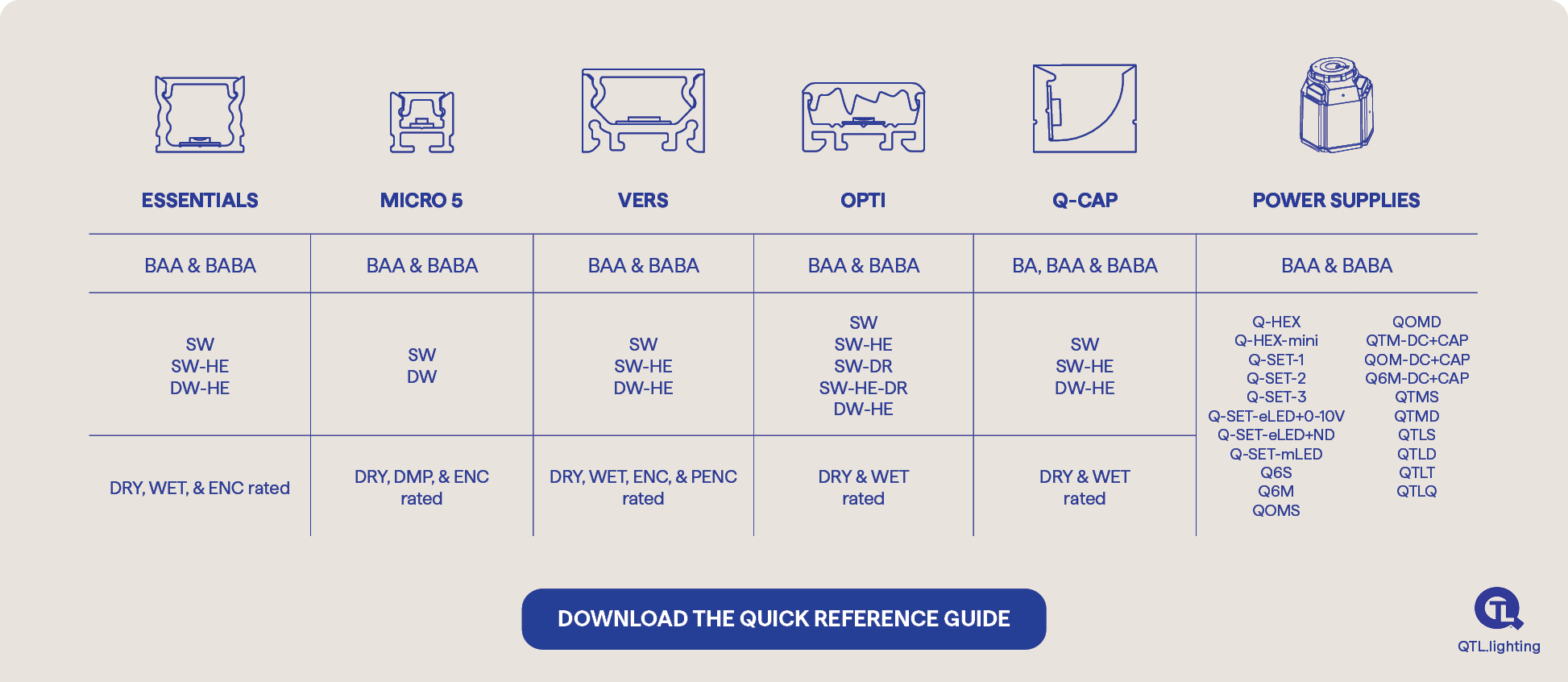
Families that meet BAA and BABA across common configurations include ESSENTIALS, MICRO 5, VERS, OPTI, and Q-CAP, along with a wide range of QTL power supplies. Q-CAP also carries BA coverage. Because compliant options are printed directly on QTL cut sheets, a lighting professional can specify a compliant configuration and see it on the same document used to order.
Compliance follows the fully manufactured item, not the parts
Program compliance attaches to the finished product that QTL builds and certifies, which is the detail that trips up most specs. Two things follow from it.
Fixtures qualify when they are factory built. Domestic manufacturing of the finished fixture is part of what qualifies it for these programs. Separately ordering the LED light engine and the extrusions to assemble in the field makes the lighting non-compliant.
Integrated and separate power supplies are treated differently. A few QTL fixtures are built with an integrated power supply, which is then part of the certified fixture. A power supply, driver, or control ordered as its own line item is evaluated on its own and has to meet the requirement independently. This is why a fixture can qualify while a remote power supply on the same bill of materials does not. Check the line items, not just the fixtures.
How do I get a compliance letter?
Most submittals require a signed compliance letter and the applicable spec sheets. Route the request through your lighting sales agency, who works with the QTL sales manager to prepare it. Because QTL prints the BAA, BA, and BABA options directly on its cut sheets, the specification is straightforward and the letter comes together quickly.
Provide the project name, the quote or bill of materials, the exact part numbers, and any agency forms or the specific standard cited. QTL can supply:
- A BAA, BA, or BABA compliance letter
- A Certificate of Compliance or Certificate of Materials Origin
- A domestic-content statement
- A non-compliance letter for items that do not qualify
What if any items on my plan cannot comply?
A non-compliant item does not necessarily lose the project. It has to be identified and justified, and QTL can help make that case.
First, look for a compliant alternative. Changing the LED family or the IP rating often moves an item into compliance. Most plans can be brought fully compliant through substitution.
If no domestic option exists, a waiver may be requested. The waiver is requested by the funding agency or the grant recipient, on grounds such as non-availability, unreasonable cost, or public interest. Manufacturers and suppliers cannot file the waiver, but they can supply the information the request depends on.
A non-availability waiver typically asks for the percentage of US content in the non-compliant item and a description of the unique benefits that make it a necessity for the project. QTL can gather those details into a letter that supports the agency's waiver request, which is how QTL-specified projects have kept non-compliant specialty items in the design and still moved forward.
What about TAA?
The Trade Agreements Act comes up occasionally on higher-value federal contracts. QTL does not mark products for TAA by default. TAA eligibility is reviewed on request through QTL.
Specify with confidence
You do not have to wait on an answer to know what qualifies. QTL prints the compliant options directly on its cut sheets and isolates compliant products by program, so a specifier or lighting sales agency can find and request the right part numbers without a back-and-forth. Start with the program your project requires:
- Buy American Act (BAA) products
- Buy America (BA) products
- Build America, Buy America (BABA) products
- American-made overview and all programs
From there, specify the factory-built configuration and request the compliance letter through your lighting sales agency and QTL sales manager. If a project raises a question the pages do not answer, QTL is happy to help.
Find your QTL rep to get started
FAQs
Is Made in USA the same as BAA?
No. Made in USA is an FTC marketing claim about country of origin. The Buy American Act (BAA) is a federal procurement rule with its own domestic-content threshold.
How is the right program determined?
By how the project is funded. A direct federal purchase is the Buy American Act (BAA). A federally funded transit or infrastructure project is Buy America (BA) or Build America, Buy America (BABA). The grantee or agency usually specifies which applies.
What are the domestic-content thresholds?
The Buy American Act (BAA) requires 65% US component cost today, rising to 75% in 2029. Build America, Buy America (BABA) requires 55%. Buy America (BA) sets no percentage. It requires that all components be of US origin, which makes it the strictest of the three. All three also require US manufacturing.
Can the same fixture meet both the Buy American Act (BAA) and Build America, Buy America (BABA)?
Yes. A product that meets the higher Buy American Act (BAA) threshold also satisfies the lower Build America, Buy America (BABA) threshold, so a BAA-compliant fixture is generally BABA-compliant as well.
Why can't every fixture assembled in the US qualify?
Because compliance is measured on the cost of components, not on assembly. LED chips and power supplies are often imported, so a fixture only assembled in the US may fall short. Domestic component sourcing is what clears the threshold.
Can I order the LED and the housing separately and assemble them on site?
Not for BAA, BA, or BABA. Compliance applies to the finished fixture QTL builds and certifies, so a field-assembled combination does not carry it. Specify the factory-built fixture.
Do integrated drivers count against the fixture?
When integrated into the luminaire, they are components of the finished product. Sold separately, they must qualify on their own.
How do I verify a manufacturer's compliance claim?
Ask for a signed compliance letter and the domestic-content basis for the specific part numbers. A genuine claim is documented at the product level, not asserted with a label.
Who requests a waiver, and can QTL help?
The funding agency or grant recipient requests it. QTL cannot file it, but can provide the US-content percentage and the unique-benefit justification the request needs, in the form of a letter.
How do I get compliance documentation?
Through your lighting sales agency and the QTL sales manager. QTL provides compliance and non-compliance letters, not waivers.