Room to Learn: School Lighting Design at Adam J. Lewis Academy
Across the classrooms and corridors of Adam J. Lewis Academy in Bridgeport, Connecticut, suspended fixtures painted in the school’s signature green bounce light off the ceilings to fill each room, and student artwork glows along the hallway walls. It is hard to picture the building as it was: a former civic administration building stripped to its shell.
Lighting designer Ken Daniel, LC, IALD, of Connecticut-based West Woods Design, used advanced LED lighting to enhance rooms throughout the campus. Daniel, whose educational lighting design work includes projects at Notre Dame and Yale, discovered a challenge with the building’s uneven ceiling heights.
The architect’s ceiling plan was his only reference. Daniel recalls the building’s condition: “It was completely gutted. It was concrete and a lot of duct work and wires.” Using his experience as well as lighting donated by QTL, Daniel helped make this pre-K through eighth-grade school a comfortable place to spend the day.
What teachers want from classroom lighting
The Academy’s mission is to give students of both need and merit the best possible education in the greater Bridgeport community. Part of that equation is a more conducive learning environment.
In an interview published online, school co-founder Patty Lewis said that 78% of the school’s students are performing at or above Connecticut standards and that parent approval ratings stand at 98%. "Students who came in with either academic or SEL challenges are now thriving. Students who spoke no English are now fluent and leaders in their class."
Creating an environment where students can thrive starts in the classroom.
"Typically, I would say lighting is not the first thing you think of when you're setting up a classroom," says Emma Salandra, who teaches sixth grade humanities at Lewis Academy, "but I think a lot of teachers end up finding it to be one of the most important pieces of having a good classroom environment."
Mismatched BOOM runs for the STEAM classroom
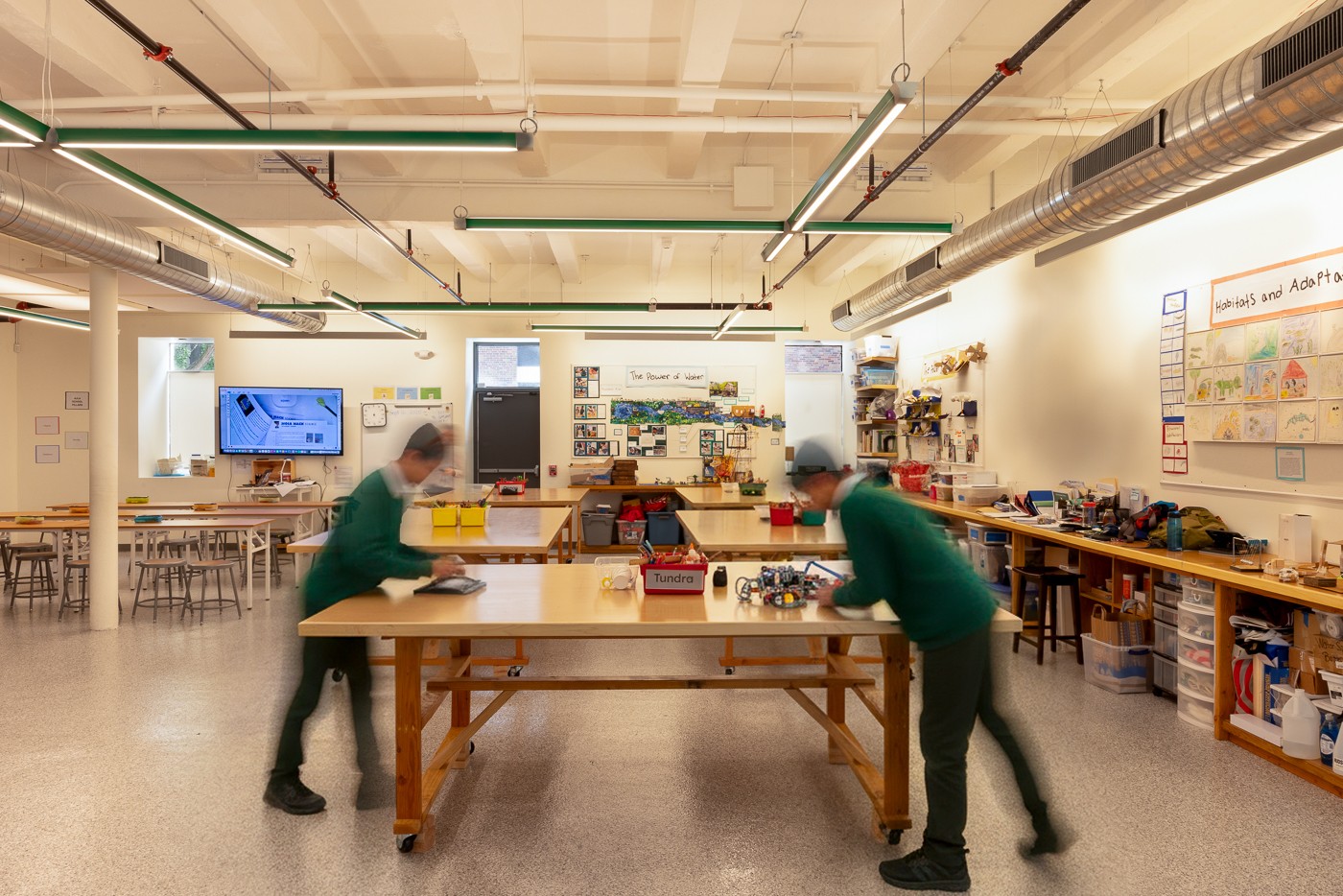
The STEAM classroom was phase one, and its lighting sets an original, creative tone. BOOM-CROSS-SHAPE (01) fixtures, each leg a different length, interconnect across the room as a dynamic, decorative accent. “It’s the first thing people notice when they walk into this room,” says Kiersten Chou, who teaches fourth through seventh grade science and STEAM (Science, Technology, Engineering, Arts and Mathematics). The varied lengths were deliberate. "If we tried to create something that was regular, it would show off the irregularity of the ceiling," Daniel explains. "So, we made these as irregular as everything else."
BOOM runs carry 6W HE up (High Efficacy that delivers more lumens per watt) and 6W HE down at 3000K. The 6W downlight, double the 3W of the standard classrooms, makes up for a ceiling that cannot bounce light the way a clean one does. A ventilation duct ruled out squeezing BOOM over the walls where the school planned to post artwork, so Daniel hung QUOVA PERFORMANCE pendant-style and rotated it a quarter turn from its intended orientation, with an asymmetric optic at 12 watts per foot. "We needed something with a lot of output to compete with the ambient lighting in the room," he says.
Suspended direct/indirect lighting for the classrooms
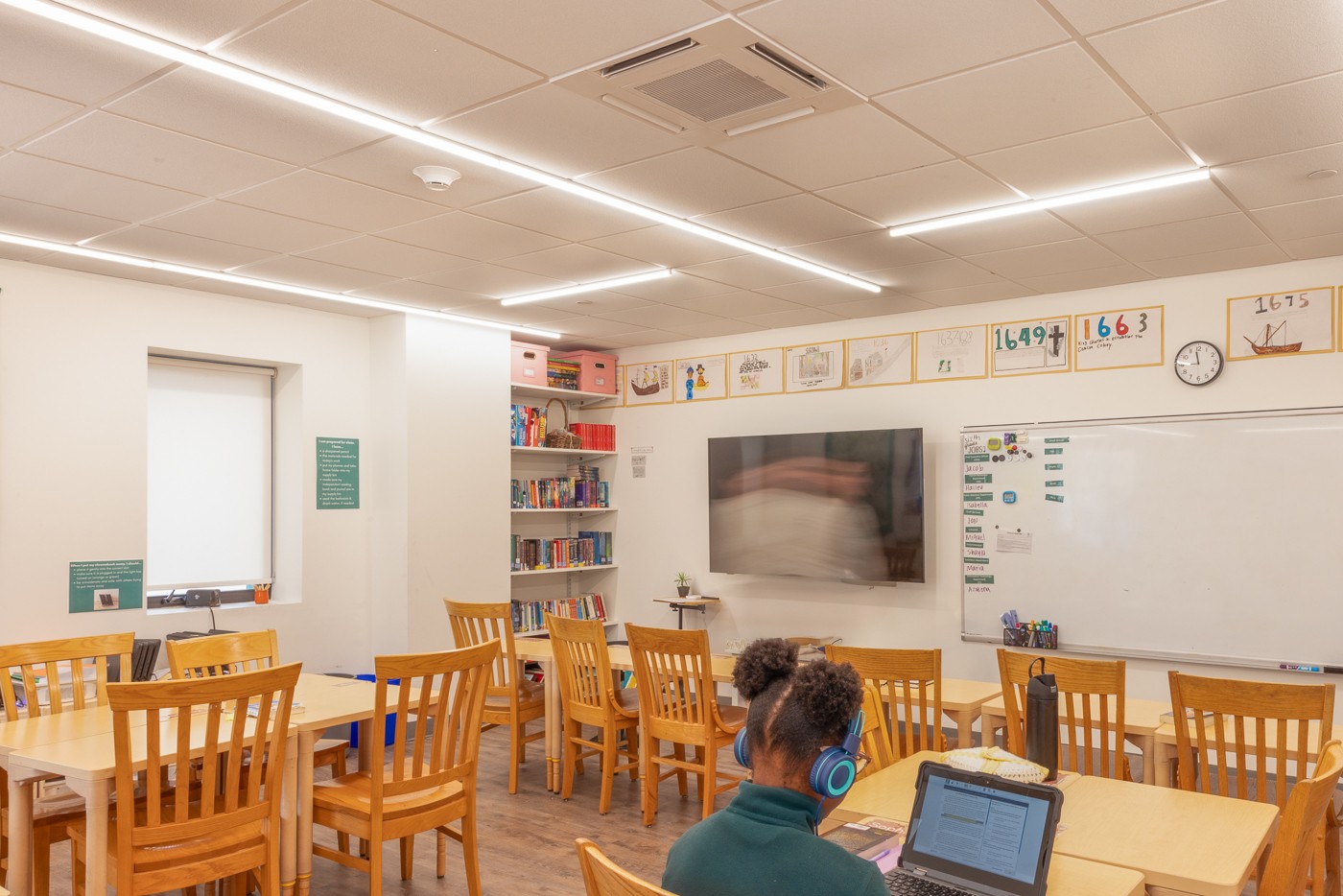
In the standard classrooms, BOOM-INLINE (01) sends 6W HE up and 3W HE down. Where ceilings sit at nine feet, it hangs at least 18 inches, with a 170-degree optic on the indirect and a diffuse lens on the downlight. "I'm relying on all the light bouncing off the ceiling," says Daniel. "That's the real workhorse."
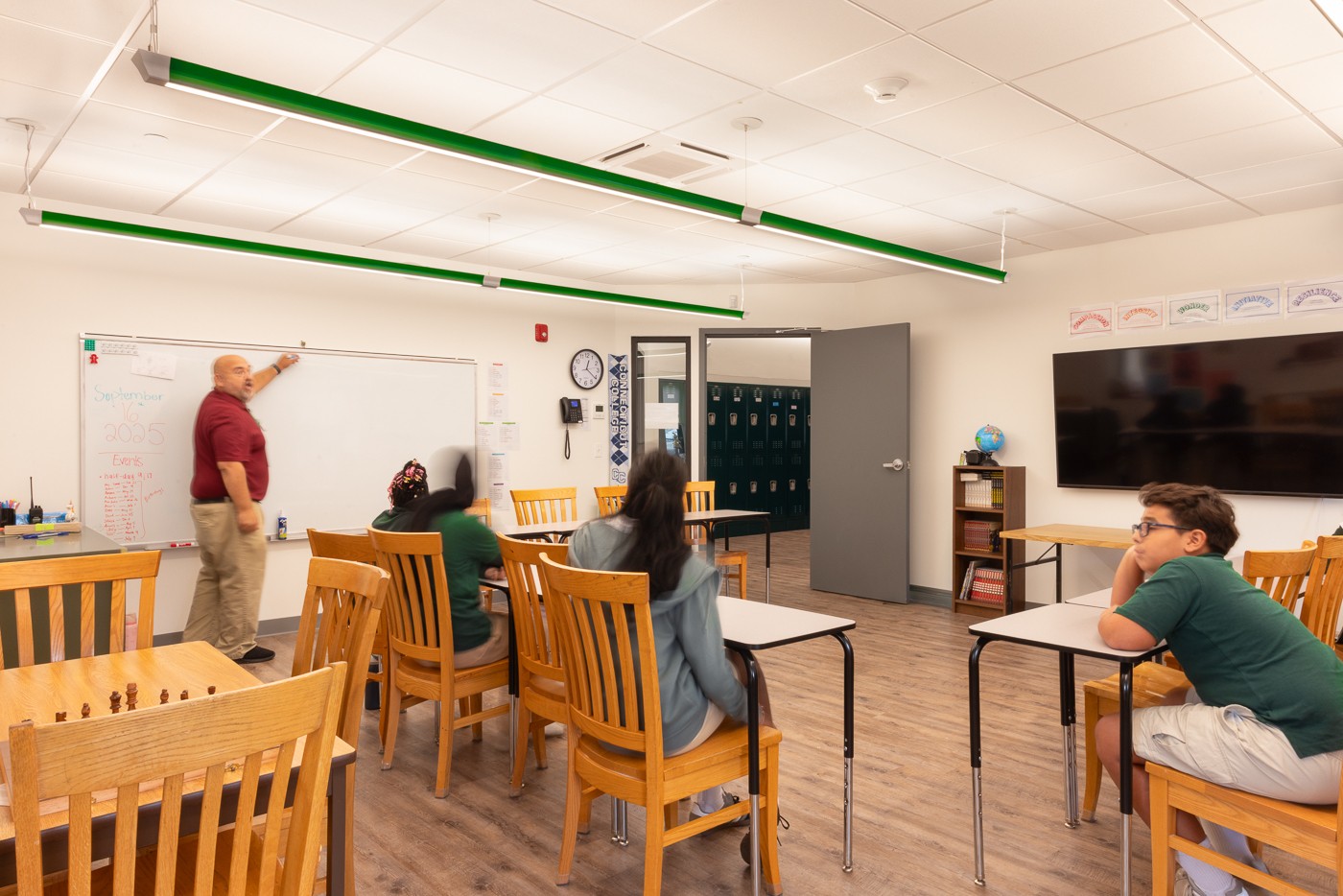
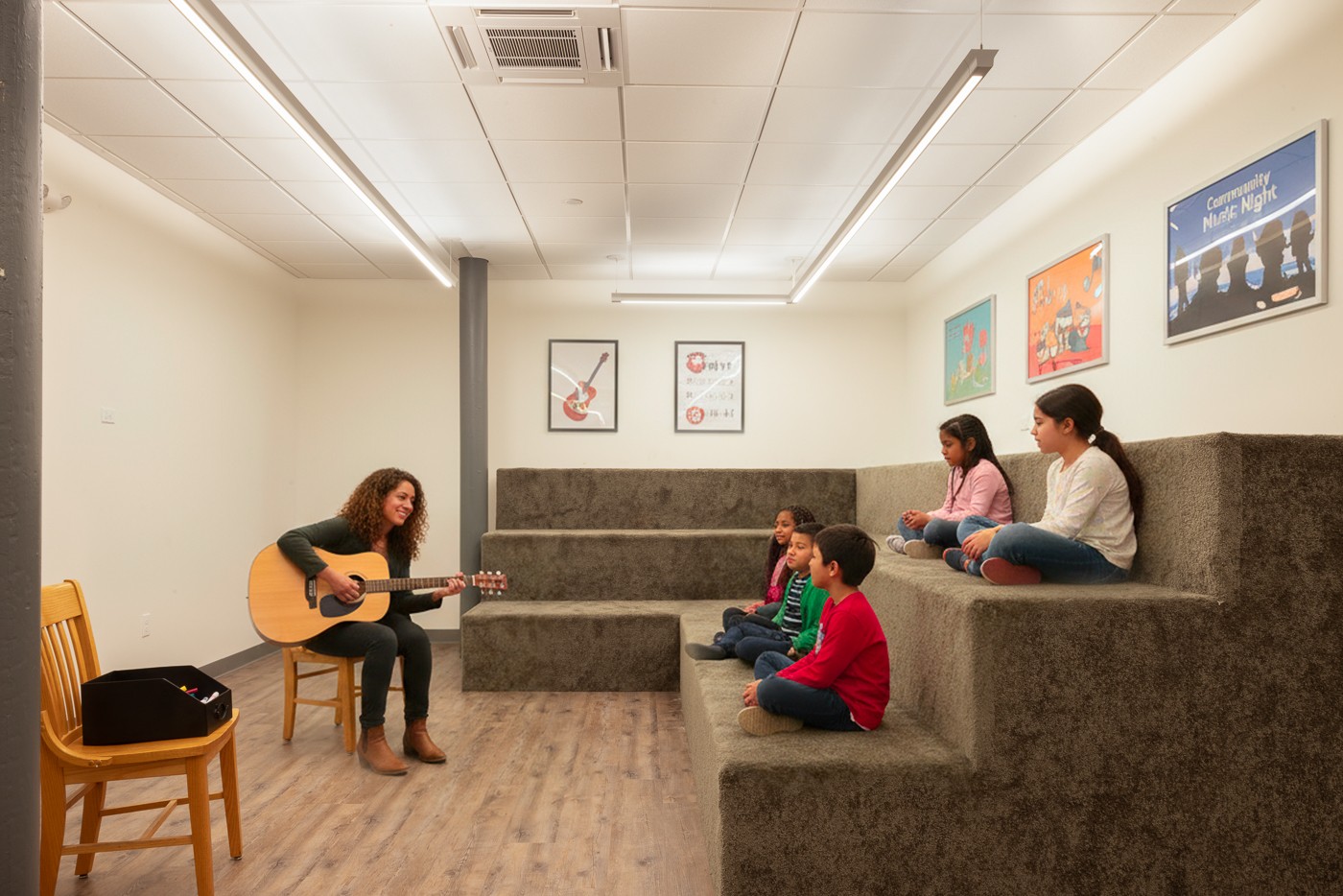
The music room called for a different shape. Daniel selected BOOM-L-SHAPE (01) fixtures because their L-shaped runs match the layout of the room.
T-bar lighting for the low-ceiling classrooms
Where the ceilings run too low for BOOM, Daniel pieced together VERS-DROP (10) in playful groupings on the ceiling grid. “With the drop, you increase the amount of lens, adding side illumination, and cut down on glare,” he notes.
Fifty footcandles at 3000K, dimmed room by room
Daniel says classroom light levels he specified are guidelines, not mandates. “In a classroom, I try to get as much as 50 footcandles on the desk,” he says. “And then certainly with the knowledge that the light can be dimmed.”
Handwork and drawing need the room at full intensity. When a class moves to tablets or laptops, dimming the lights makes the screens more comfortable to work on. Each room dims on its own over 0-10V control, and the QZ power supplies Daniel specified dim smoothly down to 0.1%, so teachers can set the light for the task at hand. "They're quite functional for the different modes we need," says Chou.
Every fixture Daniel specified runs at 3000K. "3500K is a little cold, 2700K is a little too sleepy," he says. "We don't want sleepiness."
Perimeter lighting on both sides of the corridors
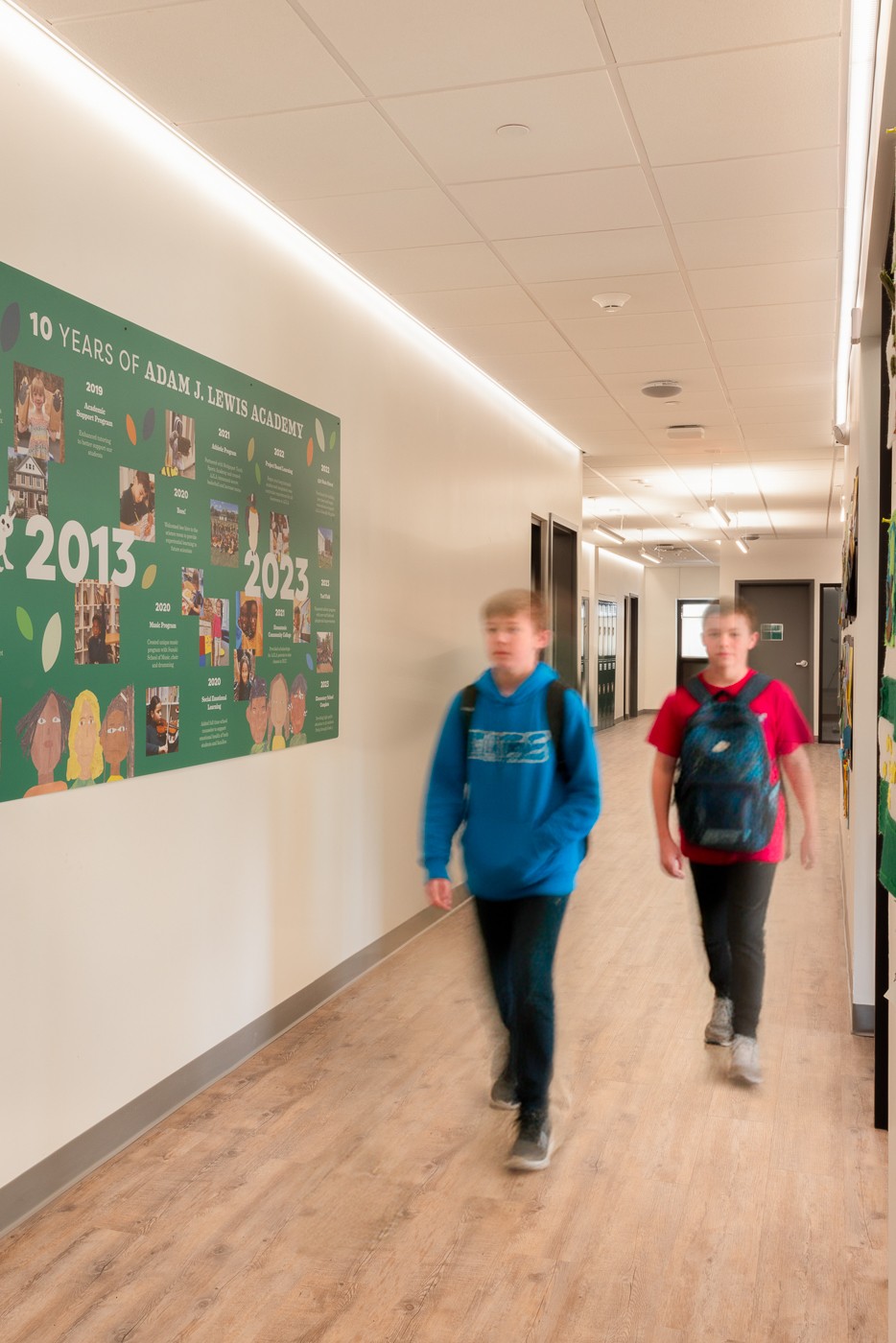
PERI runs along both sides of the corridors at 3 watts per foot, because the school planned to hang art on both walls. One lit side would have looked odd and would have called for 6 watts per foot. "The corridors are interactive, so I wanted to keep it bright in there," Daniel explained. In the wider, more open areas that connect the corridors, he hung a series of BOOM-SINGLE (01) fixtures.
Show the power supplies in the drawings
Lewis Academy runs on QZ power supplies, which Daniel calls "reliable and easy to handle and to hide." His advice to other designers is to draw them in. "I now add power supplies," he says. "I don't instruct them where they should go specifically, but it makes it a lot clearer for the installer to understand how these things are powered."
Teachers give extra credit to the light
Daniel never saw the school in session, so the verdict on how it feels in use belongs to the teachers. Salandra describes the rooms this way: "Our lighting now is great for the learning environment because it is bright enough for them to do their work, but it is not so bright or fluorescent to cause them to feel overstimulated." Chou's opinion of the fixtures is shorter. "They're truly beautiful," she says.
See QTL's education lighting, or find a rep to talk through your next school project.
FAQs
How bright should classroom lighting be?
No code sets a single light level for classrooms, so designers work from guidelines and adjust for the task. At Adam J. Lewis Academy, lighting designer Ken Daniel, LC, IALD, aims for up to 50 footcandles on the desk, since younger students doing handwork need the high end, and relies on dimming to bring levels down. QTL BOOM direct/indirect fixtures deliver that light by bouncing it off the ceiling and sending it down to the desks.
What color temperature is best for a classroom?
Many lighting designers favor 3000K for classrooms: warm enough to feel comfortable, but not so warm that students feel drowsy. Every QTL fixture at Adam J. Lewis Academy runs at 3000K. Lighting designer Ken Daniel found 3500K a little cold and 2700K a little too sleepy.
How do teachers control classroom lighting?
Room-by-room dimming lets teachers match light levels to the activity: full intensity for handwork and drawing, lower levels for more comfortable work on tablets and laptops. At Adam J. Lewis Academy, each room dims independently over 0-10V control, and QTL QZ power supplies dim the fixtures smoothly down to 0.1%.
What lighting works for classrooms with low drop ceilings?
Fixtures that mount directly to the ceiling grid keep light levels up without hanging into the room. Where ceilings at Adam J. Lewis Academy run too low for suspended fixtures, lighting designer Ken Daniel used QTL VERS-DROP (10) on the T-bar grid. Its drop lens adds side illumination and cuts down on glare.
Can classroom lighting help students who get overstimulated?
Lighting that is bright enough for schoolwork but free of harsh, fluorescent glare helps keep a classroom calm. Sixth-grade humanities teacher Emma Salandra says the lighting at Adam J. Lewis Academy “is bright enough for them to do their work, but it is not so bright or fluorescent to cause them to feel overstimulated.” The school uses QTL BOOM direct/indirect fixtures, which send most of their light up to the ceiling.
What is direct/indirect lighting, and why use it in classrooms?
Direct/indirect fixtures send light both up to the ceiling and down to the work surface. The ceiling becomes a large, soft reflector, which reduces glare and harsh shadows. In the standard classrooms at Adam J. Lewis Academy, QTL BOOM-INLINE (01) sends 6W of High Efficacy light up and 3W down, and lighting designer Ken Daniel calls the bounced light “the real workhorse.”
How should school corridors be lit for student artwork?
Lighting both walls lets displays read clearly from either side of the hall. At Adam J. Lewis Academy, QTL PERI runs along both sides of the corridors at 3 watts per foot because the school planned to hang art on both walls. Lighting one side only would have looked odd and called for 6 watts per foot.
Products Featured in This Post

BOOM-CROSS-SHAPE (01)
Suspended linear direct/indirect fixture

BOOM-INLINE (01)
Suspended linear Direct/Indirect Fixture

BOOM-L-SHAPE (01)
Suspended linear direct/indirect fixture

BOOM-SINGLE (01)
Suspended linear direct/indirect fixture for single runs up to 12' lengths

VERS-DROP (10)
Provides illumination on three sides, adding a decorative detail and extra dimension.

PERI
Easy to install perimeter lighting
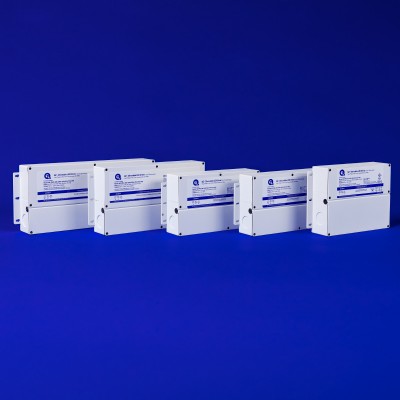
QZ-PRO-PH/0-10V
Class 2 LED drivers with integrated potentiometer to boost or dim voltage, controlling light levels at the fixture.

QUOVA PERFORMANCE STANDALONE